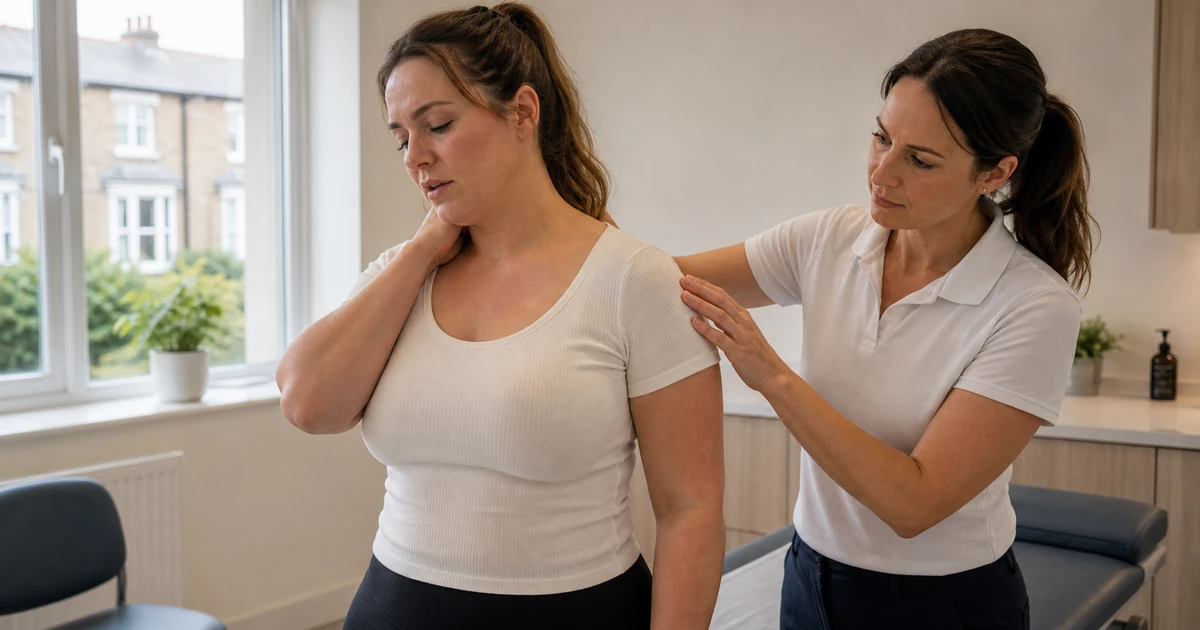
Cosmetic vs Clinically Necessary — the Core Distinction
As NHS.uk's page on breast reduction on the NHS1 explains, funding is not based on breast size alone, cup size, or appearance. The NHS draws a firm line between a purely cosmetic wish to be smaller and a documented clinical need — physical symptoms plausibly caused by breast size and weight that have not resolved with conservative measures tried first. Only the second category is ever considered for funding, and even then, whether a specific case is accepted is subject to each regional ICB's own published policy, which can differ from one part of the country to another for what looks like a similar case.
Symptoms That May Support a Referral
The national commissioning guide developed jointly by the Royal College of Surgeons of England and BAPRAS2 sets out these physical complaints as the core symptoms most ICB assessments look for:
- Chronic back, neck and shoulder pain not adequately explained by other causes.
- Shoulder-strap grooving from bra straps supporting heavy, pendulous breasts.
- Recurrent skin problems — intertrigo, infection or irritation — in the crease beneath the breast.
- Restriction of activity, including exercise, sleep and work.
- Postural change and its downstream physical consequences.
Separately, a systematic review of patient-reported BREAST-Q outcomes after reduction mammaplasty3 found consistent improvement across BREAST-Q's composite satisfaction, psychosocial, sexual and physical wellbeing domains following surgery — broader evidence that reduction surgery improves quality of life, rather than a study of this specific symptom list. Some regional policies also recognise a wider pattern of emotional and social impact — feeling self-conscious about breast size, or low mood connected to it — as part of the overall clinical picture, alongside the physical symptoms above, rather than as a standalone reason for referral on its own. Whatever the symptoms, they need to be documented over time — dated GP notes, physiotherapy records and a symptom diary all strengthen a case far more than a single description at one appointment.
Criteria ICBs Commonly Consider
Policies vary by region and change over time, but a national commissioning guide developed jointly by the Royal College of Surgeons of England and BAPRAS2, historically used to inform many local policies, illustrates the kind of factors ICBs typically weigh:
- Duration and severity of symptoms — a pattern over months or years carries more weight than a recent onset.
- Conservative measures tried first — a properly fitted supportive bra, physiotherapy, and weight management where relevant, usually need to have been attempted and shown not to resolve the symptoms.
- Estimated tissue amount to be removed — the same national guide sets an example threshold of at least 500g of tissue per breast, though local policies vary.
- BMI threshold — commonly cited example policies use a threshold around 27, applied for surgical-safety reasons rather than as a judgement on the patient. It is not a punitive measure — anaesthetic and wound-healing risk genuinely rises at higher BMI, and stabilising weight first can also make the surgical result more predictable.
- Psychological readiness — some pathways include an assessment of psychological wellbeing alongside physical symptoms, with referral to a clinical psychologist available where appropriate rather than as a barrier to surgery.
- Smoking status — smokers are commonly asked to stop for a defined period before surgery, since smoking measurably increases wound-healing complications.
These are illustrative examples, not universal or current national criteria. Individual ICB policies are reviewed and updated regularly and can set different thresholds — always check your own ICB's current published policy rather than relying on any single figure quoted here or elsewhere.
How to Start: Your GP Appointment
Bring as much documented evidence as you can to your first appointment:
- A symptom diary recording dates, pain locations and severity over time.
- Records of physiotherapy or other treatments already tried.
- Bra-fitting records, if you've had a professional fitting.
- Photographs where relevant, such as documenting skin irritation in the breast fold.
Your GP assesses your case against local ICB policy and, where criteria appear to be met, refers you on to secondary care — usually a plastic surgery or breast surgery department. If criteria are not clearly met, a good GP will still explain what additional evidence, such as a longer period of physiotherapy, might strengthen a future application, rather than simply closing the conversation.
The Individual Funding Request (IFR) Process
Where your case falls outside standard ICB policy but you and your clinician believe there are exceptional circumstances, the mechanism is an Individual Funding Request (IFR). Your GP or consultant submits this on your behalf — you do not apply directly yourself. An IFR requires a case for clinical exceptionality: evidence that your situation is materially different from the general population the standard policy was designed around, not simply that you would benefit from surgery in the way many patients would. Read the full process, including typical timescales and what makes a case stronger, in Individual Funding Requests.
Timelines vary considerably by region and by how straightforward your case is against local policy. As a general NHS standard, the NHS constitutional target4 is for patients to start treatment within a maximum of 18 weeks of a consultant-led referral — but that clock typically only starts once you've already been referred into secondary care. The GP assessment stage, any conservative treatment trial, ICB decision-making and, where needed, the IFR process itself all happen before that referral and are not covered by the 18-week standard, so the realistic overall timeline from first raising symptoms with your GP to a decision can run to many months.
If You're Refused: Appeal and Next Steps
- Request the written decision and the specific reasoning behind it — you're entitled to understand exactly which criteria weren't met.
- Discuss with your GP whether further evidence, such as a longer documented trial of physiotherapy or an updated symptom diary, would strengthen a re-application or appeal.
- Follow your ICB's formal appeal process, which must be offered to you in writing and explained clearly.
- If refused again after appeal, your realistic options are private surgery (see cost below), or waiting and re-applying later if your symptoms worsen or your circumstances genuinely change.
What the Surgery Involves & Scars
Whether funded by the NHS or arranged privately, breast reduction removes glandular tissue, fat and skin to reduce breast size and reshape the breast, repositioning the nipple on a vascular pedicle to preserve blood supply and, where possible, sensation. Scar pattern depends on the amount being removed — a vertical ("lollipop") scar for smaller reductions, or a full anchor (inverted-T) pattern for larger ones. Surgery is usually done under general anaesthetic with a short hospital stay of a day or two, and most patients need around two to three weeks away from office-based work, longer for physically demanding roles. Scars are permanent but typically fade to fine, pale lines over 12–18 months. See the full surgery guide for the complete detail, including recovery and risks.
Breastfeeding After Reduction
Many patients can breastfeed after breast reduction, but some cannot, and this varies by individual and by the surgical technique used — pedicle techniques that preserve more of the ductal system give a better chance of retained breastfeeding function. If breastfeeding in future is a priority for you, raise it explicitly at your surgical consultation so the surgeon can plan the technique accordingly, rather than assuming it will be considered by default.
Private Cost If Not Funded
If NHS funding isn't available in your case, or you decide not to pursue the NHS route, typical UK private cost is £6,500–£9,500, covering the surgeon, anaesthetist, facility fee and a defined number of follow-up appointments in a fair quote. See the full breakdown in Breast Surgery Costs.
FAQ
Can I get a breast reduction on the NHS?
It may be possible when documented physical symptoms, such as chronic back or shoulder pain, are not resolved by conservative measures and meet your regional ICB's published criteria. It is never automatic and is not based on breast size or appearance alone.
What symptoms do I need?
Persistent back, neck or shoulder pain, shoulder-strap grooving from bra straps, recurrent skin irritation beneath the breast, and restriction of daily activity such as exercise or sleep are the symptoms ICBs most commonly consider — provided they're documented over time with dated evidence, not just described at a single appointment.
Is there a BMI limit?
Many ICBs apply a BMI threshold, commonly cited around 27, mainly for anaesthetic and wound-healing safety rather than as a judgement on the patient. Exact thresholds differ by region and change over time, so check your own ICB's current policy.
How long does the process take?
Once formally referred, the NHS standard is for patients to start treatment within a maximum of 18 weeks. But the GP assessment, conservative-treatment trial and ICB decision beforehand aren't covered by that clock, so the realistic total can run to many months or longer.
What if my request is refused?
You're entitled to a written decision with reasons, and a formal appeal route through your ICB. If the appeal doesn't succeed, options are private surgery, typically £6,500–£9,500, or reapplying later if your symptoms or circumstances genuinely change.