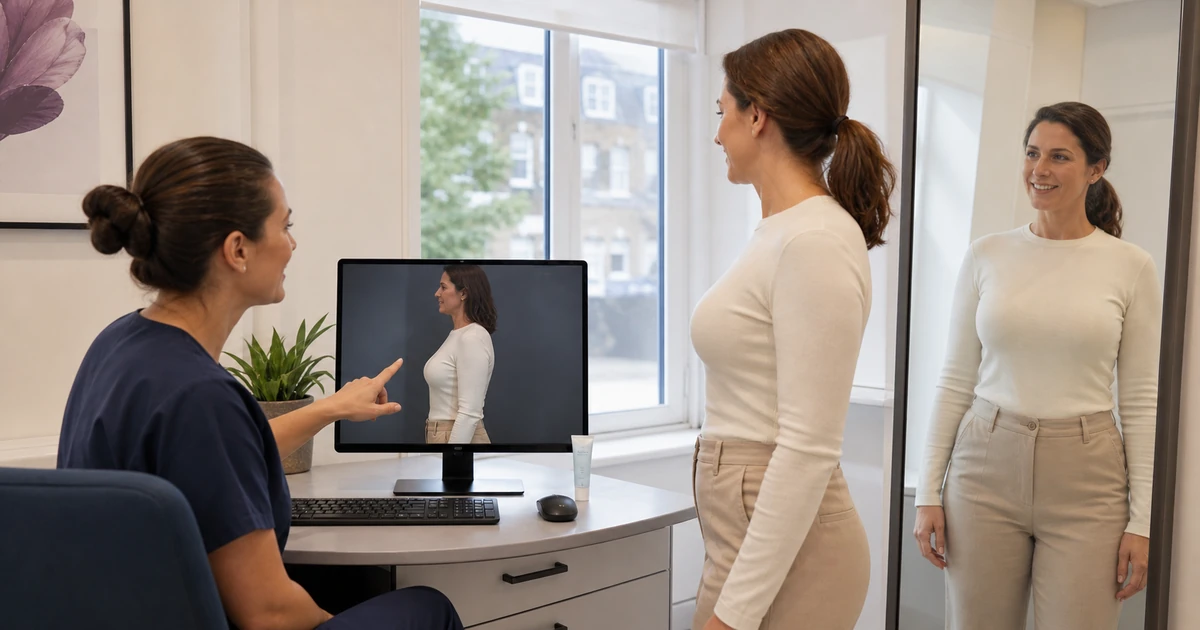
What a Lift Changes
According to BAAPS's patient information on breast uplift (mastopexy)1, the operation removes extra skin from underneath the breast, repositions the nipple higher, and reshapes the breast into a tighter, more supported shape. It does not change volume. If you also want more volume, the operation you need is augmentation-mastopexy (see Lift or Implants?).
It helps to think of a mastopexy as re-draping existing tissue over a firmer internal shape rather than adding anything new. The surgeon lifts the gland itself — not just the skin — reshaping and, in most techniques, internally securing it with dissolvable sutures so the new position holds once the skin has redraped around it. The nipple-areola complex is moved to sit at or near the natural high point of the breast, roughly level with the crease underneath, and is usually resized slightly if it has stretched. This is why a good "before and after" pair of photos of a lift tends to show a breast that looks fuller in the upper pole and firmer overall, even though no tissue has been added — it is the same volume, repositioned and supported higher on the chest wall.
This distinction matters most at consultation. Patients who describe wanting their breasts to look "bigger, but also higher and firmer" are often actually describing two separate problems — ptosis (sagging) and volume loss — that need two different solutions. A lift on its own addresses only the first. Surgeons will typically grade the degree of ptosis using the Regnault classification of breast ptosis, which ranks the position of the nipple relative to the inframammary fold2, to decide how much lifting is needed and whether volume should be discussed as a separate, combinable procedure. Being clear about which change you're actually seeking — position, volume, or both — is one of the most useful things you can bring into a consultation.
Results by Incision Type
Which incision pattern suits you is a case-by-case decision best discussed at consultation — see BAAPS's patient information on breast uplift (mastopexy)1, which notes that different types of uplift produce different scars and that the best type for you depends on your breast size and the result you want. The pattern chosen is not a cosmetic preference on the surgeon's part — it is dictated almost entirely by how much excess skin has to be removed and how far the nipple has to travel to reach its new position. As a rule, the more lift required, the longer the scar needed to redistribute the skin without leaving puckering or "dog ears" at the ends of the incision.
Periareolar (Circumareolar / "Doughnut")
A scar around the areola. Suited to very small lifts. Limited by how much lift it can produce; larger lifts stretch the areola.
Because the entire incision sits at the areola's edge, the resulting scar tends to be the least visible of the three patterns once it has matured — it follows the natural colour change between areola and breast skin. The trade-off is mechanical: only a limited amount of skin can be removed this way before the areola is pulled into an oval or the surrounding skin puckers ("bunching"), so surgeons reserve this approach for patients who need only a modest amount of nipple repositioning, often combined with a small implant.
Vertical (Lollipop)
Around the areola plus a vertical line to the fold. Suited to moderate lifts. Good balance of scar length and lift.
This is the most commonly used pattern for moderate ptosis because it removes a meaningful amount of skin both around the areola and down the lower pole, allowing the gland to be reshaped into a more projected, conical form rather than simply flattened. The vertical scar usually settles into a fine line running from the areola down towards (but not reaching) the breast crease, and most surgeons will avoid extending it onto the chest wall itself.
Anchor (Inverted-T / Wise Pattern)
Periareolar + vertical + horizontal along the fold. Standard for larger lifts and after significant weight loss. Larger scar burden; more shape control.
The added horizontal component along the inframammary fold lets the surgeon remove significant amounts of loose skin from the base of the breast, which is essential after major weight loss or in cases of severe ptosis where the nipple sits well below the fold. It gives the most control over reshaping a very stretched envelope, but it is also the pattern most likely to need scar revision if healing is imperfect, since the T-junction where the three lines meet is under the most tension.
Why Early Photos Differ From Final Results
The breast sits high and full immediately after surgery. Over 3–6 months tissue relaxes and the shape settles ("drop and fluff"). An 8-week photo isn't the final look; a 6-month photo is closer.
This happens because swelling and the internal sutures used to reshape the gland hold the breast in an artificially high, tight position in the first weeks. As post-surgical oedema resolves and the internal tissue gradually relaxes into the pocket created for it, the lower pole fills out and the breast "drops" slightly while the upper pole "fluffs" — softening from the immediate post-op look into a more natural contour. Patients who compare their own 6-week photo unfavourably to someone else's 6-month result are often, without realising it, comparing two very different stages of healing rather than two different outcomes. If a clinic's gallery doesn't label the time-point of each "after" photo, that is worth asking about directly — reputable practices will tell you.
Swelling can also be asymmetric in the first few weeks, resolving slightly faster on one side than the other, which is normal and not a sign that the result will be uneven. Genuine asymmetry is usually only assessed once both breasts have fully settled, typically from the three-month mark onward.
Given how much early photos can differ from the final result, it's worth knowing what to look for when a clinic shows you its own before-and-after gallery at consultation. First, check the time-point: ask specifically how many months post-surgery each "after" photo was taken, and be cautious of a gallery that doesn't state this at all. Second, check consistency of pose, lighting and camera distance between the "before" and "after" images — a genuine comparison uses matched angles and lighting; a flattering "after" taken from a different angle or under softer light tells you very little about the actual surgical result. Third, look for a spread of starting degrees of ptosis rather than a handful of ideal-candidate cases, since a gallery limited to the most favourable outcomes doesn't represent what your own result is likely to look like. It is also reasonable to ask the surgeon how many of their own patients have needed a scar revision, and to ask to see the same patient at both 3 months and 12 months where possible. A gallery is only ever one part of the picture — see the site's guide to choosing a surgeon for how to verify the credentials of whoever is showing you those photos.
Scars Are Part of the Result
Scars are inevitable in any technique, and as a general principle of wound healing, they mature over time — fading from pink/raised in the early weeks to pale/flat, a process that NHS guidance on scars notes can take up to two years or more3. Silicone sheeting, sun protection and time all help. They don't disappear. If a marketing photo suggests otherwise, be sceptical.
In the first six weeks, scars are typically pink or red, slightly raised, and can feel firm or itchy as collagen remodels underneath the skin. Between three and twelve months they usually flatten and lighten considerably, though the exact pace varies a great deal between individuals — skin type, tension on the wound, and even genetics all play a part, and darker skin tones can carry a higher risk of visible pigment change or, less commonly, keloid formation. Sun exposure on an immature scar can lock in discolouration permanently, which is why surgeons advise strict sun protection over the healing scar for at least a year. No cream, tape or laser treatment will make a scar vanish entirely; the honest goal is a fine, pale line that is easily hidden by ordinary underwear or swimwear, not invisibility. Any before-and-after gallery that shows zero visible scarring at any time point should be treated with caution — it either shows a very early angle that hides the scar, heavy retouching, or is simply not representative.
Will I Look Smaller?
A lift alone doesn't reduce volume, but the breast can look smaller because tissue is repositioned higher on the chest wall. If you want bigger, you need implants too.
The perception of "smaller" usually comes from two things happening at once: the removal of loose, overhanging skin (which reduces the visual bulk of the breast even though the gland underneath is unchanged) and the upward repositioning of tissue, which changes how the breast sits in a bra or clothing. Some patients also lose a small amount of true volume as an unavoidable side effect of trimming very stretched or thinned skin and fat during the lift, particularly in cases of significant ptosis — but this is incidental to the procedure, not its purpose. If your primary goal is a larger cup size as well as a lifted position, that combination is called augmentation-mastopexy: implants are the only way to significantly increase fullness above the nipple, though their added weight can itself contribute to the breast drooping again over time4. It carries its own considerations around timing, implant size, and healing that differ from a lift-alone procedure — see Lift or Implants? for the full decision guide, including UK cost ranges and how surgeons decide whether to combine the two operations in one sitting or stage them.
How Long Results Last
Gravity, ageing, weight fluctuation and pregnancy all continue after a lift. Results last but they are not frozen in time. Some patients need further tightening over 10–20 years.
A mastopexy resets the position of the breast tissue and skin envelope, but it doesn't stop the biological processes that caused ptosis in the first place. Skin elasticity continues to decline with age, and significant weight gain or loss, as well as pregnancy and breastfeeding after the procedure, can stretch the skin envelope again and cause the breast to descend once more. Patients who are planning future pregnancies are often advised to discuss timing carefully with their surgeon — some choose to have a lift after their family is complete specifically to avoid this. Results also tend not to last as long in women with heavier breasts, since there is simply more tissue weight for gravity to act on4. Recovery to a desk job typically takes around two weeks, though heavier lifting and upper-body exercise are usually restricted for longer; this is broadly consistent with the recovery window discussed on the Lift or Implants? guide. In terms of longevity, most patients can expect their result to look recognisably similar for well over a decade, with a gradual, gravity-driven softening rather than a sudden change — which is a very different pattern from the abrupt shift a marketing photo might suggest either way.
FAQ
Does a breast lift make breasts smaller?
A breast lift (mastopexy) does not remove breast volume — it repositions the nipple and reshapes the skin envelope. Breasts can look visually smaller afterwards because excess skin is removed and tissue sits higher and firmer on the chest, but no glandular tissue or fat is taken out.
How long do results last?
A breast lift's results commonly last well over a decade, but gravity, skin ageing, weight fluctuation and any future pregnancy or breastfeeding continue afterwards. Some patients eventually choose a further lift after 10–20 years as natural sagging gradually recurs; it is a durable result, not a permanent one.
Will scars be visible?
Yes. Every breast lift incision leaves a permanent scar, whichever pattern (periareolar, vertical or anchor) is used. Scars are typically pink and raised at first, fading to pale, flat lines over 12–18 months with proper care, but they do not disappear completely, even years later.