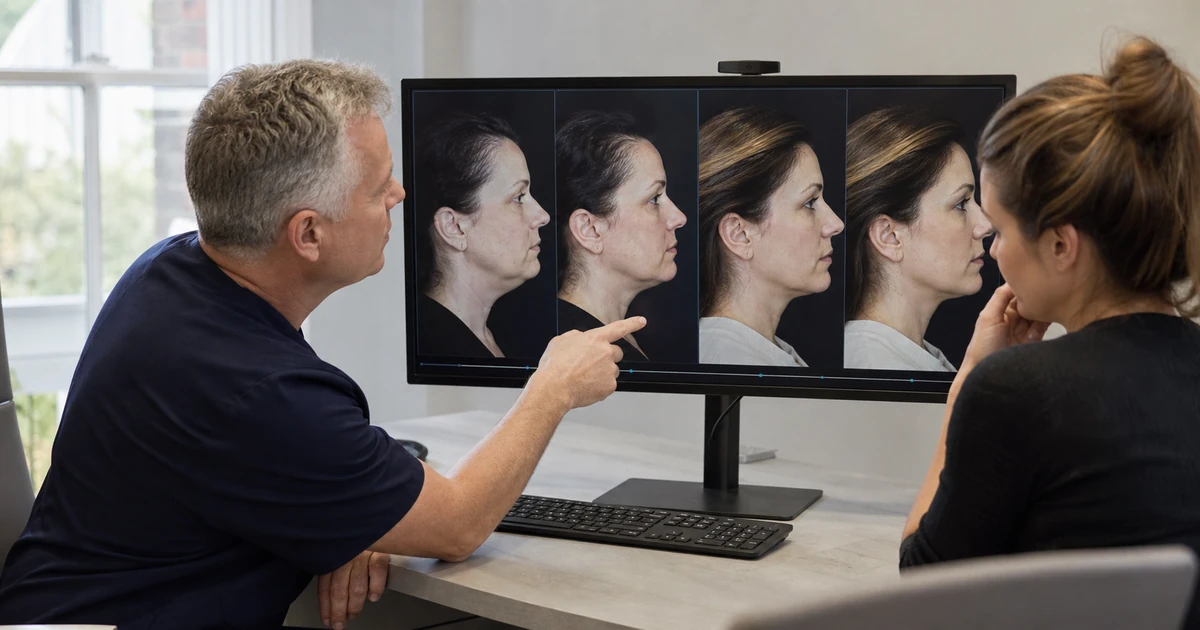
Why This Site Doesn't Publish Before/After Photos
This is a stance used consistently across this site's guides. We don't publish patient before/after photographs, for two main reasons: patient privacy around intimate or identifiable imagery, and the fact that natural anatomical variation between people means a photo of one person's result can be indistinguishable from another person's untouched baseline. See Labiaplasty Before & After: Setting Realistic Expectations for a detailed worked example of this reasoning applied to one procedure. The rest of this page focuses on how to critically read other sites' and clinics' before/after photos, since you will inevitably encounter them during your own research. General patient guidance on researching cosmetic procedures independently, rather than relying on marketing imagery alone, is available from NHS.uk's guidance on what to do before you have a cosmetic procedure2.
It's worth being upfront about why this matters so much in cosmetic surgery specifically, more than in most other kinds of consumer decision. Unlike a product review or a restaurant photo, a before/after photo is being used to help you decide whether to undergo an irreversible surgical procedure on your own body. A photo that flatters the result more than reality warrants doesn't just create mild disappointment the way a misleading product photo might — it can shape a decision that's expensive, physically permanent and difficult to reverse. That's precisely why this page treats photo literacy as a genuine safety skill, not simply a marketing nuisance to shrug off.
Camera Angle Changes the Apparent Result
A "before" photo taken face-on and an "after" photo taken at a slightly rotated three-quarter angle can make a change look larger or smaller than it actually is. Profile, three-quarter and face-on views of the same result can tell noticeably different visual stories — a rhinoplasty tip refinement, for example, often looks most dramatic from a true profile shot and far more subtle from face-on, regardless of which angle more fairly represents the change a patient will actually see day to day in the mirror. Always check whether the before and after photos were taken from a genuinely matched angle, ideally with the camera at the same height and distance from the patient in both shots.
Watch, too, for a subtler version of this problem: a patient photographed standing slightly turned away from the camera in the "before" shot and squared-on in the "after" shot. Body position, not just camera position, changes how a torso, waistline or chest appears, and a small rotation of the patient's own stance can visually flatter a result as effectively as moving the camera itself.
Lighting Differences Exaggerate or Hide Change
Harsh, angled sidelight creates shadows that exaggerate contours, hollows and definition — making a subtle change look dramatic. Flat, even lighting does the opposite, smoothing out detail and hiding a genuine change. Comparing a harshly lit "after" photo to a flatly lit "before" photo (or vice versa) is not a fair comparison. Clinical photography studios that take this seriously use standardised lighting rigs specifically so that lighting is not a variable between the two shots — the presence of a proper photography setup, rather than photos that look like they were taken on a phone in a treatment room with the overhead lights on, is itself a small positive signal about how carefully a clinic documents its results.
Skin tone can also shift under different lighting temperatures — a warmer light source can make skin look more even and healthy, while a cooler, clinical light can emphasise redness, blotchiness or bruising. If an "after" photo is lit noticeably warmer than the "before" photo, some of the apparent improvement in skin appearance may be the lighting rather than the surgery or treatment itself.
Staged Posing vs Consistent, Natural Positioning
Beyond camera angle and lighting, the patient's own pose can be quietly staged to flatter the "after" result. A patient standing with shoulders pulled back and stomach drawn in for the "after" photo, compared with a relaxed, natural stance in the "before" photo, will look different regardless of what surgery actually changed. The same applies to facial expression — a genuine smile engages muscles across the whole face and can subtly change the appearance of cheeks, jawline and under-eye area compared with a neutral expression.
A trustworthy set of photos uses the same pose, the same expression (usually neutral, looking directly at the camera), the same framing and the same background in both shots, with nothing to distinguish them except the passage of time and the surgical change itself. If a gallery's "after" photos consistently show patients in a more flattering, more posed stance than the "before" photos, treat the comparison with more scepticism, not less — consistent, almost clinically plain photography is a positive sign, not a lack of polish.
Makeup and Contouring on "After" Photos
Contour makeup, concealer and strategic highlighting can make an untreated area look more defined or symmetrical than it actually is. If an "after" photo includes visible makeup while the "before" photo does not, the comparison is no longer purely about the surgical result. This is a particular concern around the face — under-eye concealer after a blepharoplasty, or contouring along the jawline after a facelift or buccal fat removal, can visually reinforce a surgical result well beyond what the surgery alone achieved.
It's reasonable to ask a clinic directly whether their before/after photos are taken with the patient wearing makeup, and if so, to ask whether that's consistent between the before and after shots. A clinic that photographs patients bare-faced in both sets, even though bare-faced photos are sometimes less immediately flattering, is giving you a more honest basis for comparison than one that allows makeup only in the "after" set.
Swelling-Stage Timing: A Day-14 Photo Is Not the Final Result
Healing timelines vary by procedure, but a common pattern across this site's procedure guides is that early photos overstate — or understate — the eventual outcome, because swelling is still resolving. Nose Job Before & After makes this point specifically for rhinoplasty, where the nasal tip can take 6 to 12 months to fully settle, and Buccal Fat Removal Before & After makes the same point for facial contouring, where the true result only becomes visible around 2–3 months. A photo taken at 14 days after surgery, for almost any procedure, is a preview of healing in progress, not the final result — swelling, bruising and tissue firmness at that stage can all still meaningfully change over the following months.
This works in both directions. Sometimes an early photo understates the eventual result, because residual swelling is masking the final contour and the patient looks less refined than they eventually will. Other times, particularly with breast or body procedures, early post-operative swelling can make a result look fuller or more dramatic than the settled outcome that follows once swelling resolves and the tissue softens into its final position. Either way, a single early photo tells you about healing at that specific moment, not about the surgery's true outcome.
What to ask for instead: request to see genuine 6-month or 12-month results, not just the earliest available photos, and ask the clinic directly what stage of healing each photo in a gallery represents. A clinic that labels its photos clearly with the exact time elapsed since surgery — "6 months post-op", not simply "after" — is giving you meaningfully more useful information than one that leaves the timing ambiguous. If a gallery only ever shows early-stage photos and none from 6 months or later, ask why directly; it's a fair question, and a transparent practice should have a straightforward answer.
Selection Bias: Clinics Show Their Best Cases
A published photo gallery is, by its nature, a curated selection. Clinics understandably showcase their most flattering, most successful results — not their average outcomes, and certainly not their revision or unsatisfactory cases. A gallery of excellent results tells you what's possible in the best case, not what's typical. This is a structural feature of any marketing gallery, not necessarily evidence of dishonesty on any individual clinic's part — but it means the photos alone cannot tell you what to expect for yourself. This is a widely echoed piece of good practice: focus on realistic, typical outcomes for your own anatomy rather than a clinic's curated best-case gallery.
One practical way to counter selection bias at consultation is to ask to see photos of patients with a starting point similar to your own — similar skin type, similar degree of asymmetry, similar age or tissue quality — rather than simply the clinic's headline gallery. A surgeon confident in their typical results should be able to show you, or at least describe honestly, what an average result looks like for someone in your specific situation, not only their single most striking case from the last few years.
The ASA/CAP Position on Before/After Imagery
ASA/CAP guidance on cosmetic interventions1 specifically flags before/after imagery as high-risk for creating misleading impressions of typical results in advertising. This reflects exactly the concerns above — angle, lighting, timing, posing and selection can all combine to present an unrepresentative picture, even without any single photo being technically "faked" or digitally altered. Advertising that uses before/after photography is expected to represent typical, not best-case, results, and to avoid techniques — camera tricks, misleading lighting, selective cropping — that exaggerate the apparent change.
This matters for how you read galleries in practice: the existence of advertising guidance doesn't mean every gallery you encounter fully complies with it, and enforcement happens after the fact, typically in response to a complaint, not before an image is published. Treat ASA/CAP guidance as confirmation that these concerns are recognised and regulated in principle, not as a guarantee that every photo you see has already been checked against it.
Why an Absent Gallery Isn't Automatically a Red Flag
It's tempting to treat a clinic or surgeon with no before/after gallery at all as automatically suspicious, on the assumption that they have something to hide. That's not a safe assumption either way. Some genuinely excellent, highly experienced surgeons deliberately limit or avoid publishing galleries, particularly for procedures — such as labiaplasty or certain facial procedures — where results are highly individually identifiable even when a patient's face or other identifying features are cropped out. A surgeon prioritising patient privacy over marketing reach is not, on that basis alone, less competent.
Equally, a newer surgeon may simply not yet have built a gallery of patients willing to consent to photo publication, which says something about how long they've practised but not necessarily about their skill. The absence of a gallery is best treated as a neutral fact requiring a follow-up question, rather than either a red or green flag on its own. Ask directly why a clinic doesn't publish photos, and judge the answer — a considered explanation about privacy is very different from an evasive non-answer to a straightforward question.
What to Do Instead of Relying on Galleries Alone
Because photos, however carefully read, have real limits, use them as one input alongside several others rather than the deciding factor. Ask to see a broader set of results in person at consultation, including examples the clinic hasn't chosen to publish publicly, and pay attention to how the surgeon talks about the images — a surgeon who volunteers the healing timeline, angle and any limitations of a given photo is engaging with the evidence honestly, in a way that a purely promotional gallery caption cannot replicate. Combine photo evaluation with the site's full consultation questions guide, which covers what to ask about the surgeon's specific experience and complication rate directly, and with independent verification of their GMC Specialist Register entry — credentials and candid conversation tell you more, together, than any single gallery of photos ever can on its own.
FAQ
Why doesn't this site publish patient before/after photos?
For patient privacy and because natural anatomical variation means photos can be misleading about what counts as a typical or successful result. This site teaches you to critically evaluate galleries you find elsewhere rather than publishing its own.
Is a 2-week after photo a final result?
No. Swelling and tissue settling can continue for 6 to 12 months depending on the procedure. A photo taken at day 14 shows an early healing stage, not the final outcome — ask to see results from 6 months or later.
Do ASA/CAP rules cover before/after photos in cosmetic surgery advertising?
Yes. ASA/CAP guidance on cosmetic interventions flags before/after imagery as high-risk for creating misleading impressions of typical results, covering angle, lighting, retouching and selective case presentation.
Is it a red flag if a clinic has no before/after gallery at all?
Not automatically. Some reputable surgeons limit galleries for patient privacy or because their caseload is too individually identifiable. Absence of a gallery is neutral; what matters more is how a clinic answers direct questions about typical results.